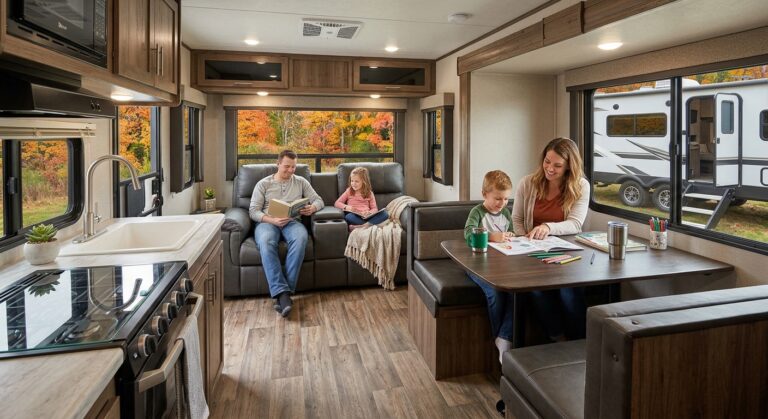
As autumn sets in across Northern Ontario, many RV owners find themselves parking their trailers for the season, draining lines, and wrapping up their final journeys. If you are debating an RV upgrade, the end of the camping season offers a natural pause to reflect on how your travel trailer served you throughout the spring, summer, and early fall. While the details of your trips are still fresh in your mind, this is an ideal window to consider whether your current trailer continues to suit your travel style.
Deciding whether to keep your existing unit, make simple aftermarket adjustments, or trade in for a new model comes down to evaluating how well your current setup fits your lifestyle. Here is an actionable guide on how to evaluate an RV upgrade before planning for next season.
1. Did You Outgrow Your Current Travel Trailer Floorplan?
One of the most frequent catalysts for an RV upgrade is a shift in who travels with you. Family dynamics change: a trailer that served toddlers well quickly feels cramped once teenagers need dedicated space. Conversely, empty nesters often tow empty bunks they no longer use.
Travel trailers follow standard layout designations tailored to distinct styles of camping:
-
Bunkhouse (BH) Models: Feature dedicated rear or mid-coach bunks (single bunks up to double-over-double configurations). Paired with convertible dinettes, they accommodate 6 to 10 sleepers without constant furniture re-arranging.
-
Murphy Bed & Trifold Layouts: Maximize living area in compact trailers by folding beds away during the day, though converting furniture morning and night can become tedious on extended trips.
-
Rear Living (RL) Configurations: Ideal for couples, placing theater seating, tri-fold sofas, and large panoramic windows at the rear, while positioning a private master suite at the front.
-
Rear Bath (RB) Floorplans: Dedicate the entire rear width to a spacious bathroom, maximizing kitchen and living efficiency in shorter lengths.
To see how these layouts compare in person, browse our current new RV inventory or review all the Jayco floorplans that match your family’s travel habits.
2. Are Minor Inconveniences Becoming Habitual Roadblocks?
Reflecting right after the camping season provides an accurate picture of your ownership experience. In the middle of a trip, inconveniences feel like part of the adventure. By pack-up time in October, true friction points stand out:
-
Did setting up and breaking down camp take up hours of relaxation time?
-
Did rainy days inside feel uncomfortably cramped?
-
Did you have sufficient counter space for meal prep and cooking?
Differentiate between problems resolved with organizers or accessories, and structural bottlenecks that only a different trailer layout can fix.
3. Can Your Setup Handle Extended-Season Weather?
For Northern Ontario campers, exploring provincial parks earlier in May or deeper into October brings cold-weather performance into focus. Standard lightweight trailers are built for warm summer weather, leaving plumbing lines and interior comfort vulnerable when overnight temperatures approach freezing (0°C / 32°F).
When researching an extended-season RV upgrade, look for specific cold-weather packages:
| Cold-Weather Feature | How It Operates | Real-World Limitation |
| Heated Enclosed Underbelly | Ducts forced warm air from the furnace into the subfloor cavity | Requires continuous furnace run time; space heaters will not protect underbelly lines |
| 12V Tank Heating Pads | Electric thermal pads adhered directly to holding tanks | Prevents freezing at the drain gate, but plumbing feed lines still require ambient heat |
| High-Output Central Furnace | 30,000–35,000 BTU forced-air heating | Higher propane consumption and increased interior condensation |
| Reflective Foil Insulation | Reflects radiant heat back into living quarters | Helps retain heat, but wind chill on the road can still freeze exterior low-point drains |
Note: RV warranties typically exclude freeze damage, meaning trailer water lines must still be winterized when sustained freezing conditions occur.
4. Does Your Tow Vehicle Have Sufficient Payload Capacity?
Before committing to a larger RV upgrade, verify what your vehicle can safely carry. Stepping up in length or slide-outs adds significant tongue and axle weight.
Tow vehicle capability involves two distinct metrics: maximum towing capacity and payload capacity. While truck marketing emphasizes tow capacity, payload is almost always the true limiting factor on conventional bumper-pull travel trailers.
-
Payload Capacity: Located on the yellow driver-door jamb sticker. It represents the Gross Vehicle Weight Rating (GVWR) minus the vehicle’s empty curb weight. It must cover all passengers, cargo, the hitch mechanism, and trailer tongue weight.
-
Tongue Weight Reality: For safe towing and sway control, conventional trailers require 10% to 15% of their total loaded weight directly on the hitch ball. A 7,000 lb loaded trailer transfers 700 to 1,050 lbs directly onto your truck’s payload capacity.
Review legal safety definitions and trailer limits through the Ontario Ministry of Transportation Towing Guide prior to purchasing a heavier unit.
5. Do Your Tank Capacities Support Longer Stays?
Transitioning from weekend trips to multi-week dry camping demands larger holding tanks and higher Cargo Carrying Capacity (CCC):
-
Compact Trailers (< 24 ft): Typically hold 20–45 gallons of fresh water and 20–30 gallons of black/grey water.
-
Full-Size Conventional Trailers: Often offer 45–60+ gallons of fresh water and 60–80+ gallons of grey capacity (often split across separate galley and bathroom tanks).
Keep weight in mind: fresh water weighs approximately 8.34 lbs per gallon (1 kg per litre). Traveling with a full 60-gallon tank adds over 500 lbs to your trailer’s gross weight, directly reducing cargo capacity for gear and provisions.
6. Could Targeted Modifications Solve the Problem Instead?
An RV upgrade is not always required. Ask yourself if targeted modifications can solve your pain points for a fraction of the investment:
-
Sleeping Comfort: Replacing a standard factory mattress with a residential-grade foam mattress.
-
Off-Grid Power: Upgrading to lithium (LiFePO4) batteries and solar panels to extend battery life without running a generator.
-
Suspension Upgrades: Installing heavy-duty shackle kits or wet bolts to smooth out rough highway travel.
If structural space, slide-outs, or towing dynamics are the root problem, aftermarket accessories will not solve it, signalling it is time for a new floorplan.
7. What Are Your Camping Goals for the Next 3 to 5 Years?
Look forward: will you be staying at full-service resort sites, exploring off-grid crown land, or traveling cross-country? Aligning your trailer purchase with a multi-year plan prevents trading in prematurely down the road.
Planning Your Next Camping Season
Evaluating an RV upgrade during the autumn months gives you ample time to inspect floorplans, calculate vehicle limits, and take advantage of off-season trade-in values without rushing.
If you are reviewing your options or want an accurate payload and tow-matching assessment, contact the team at Christie’s RV to walk through floorplans and find the ideal travel trailer for your upcoming adventures.